


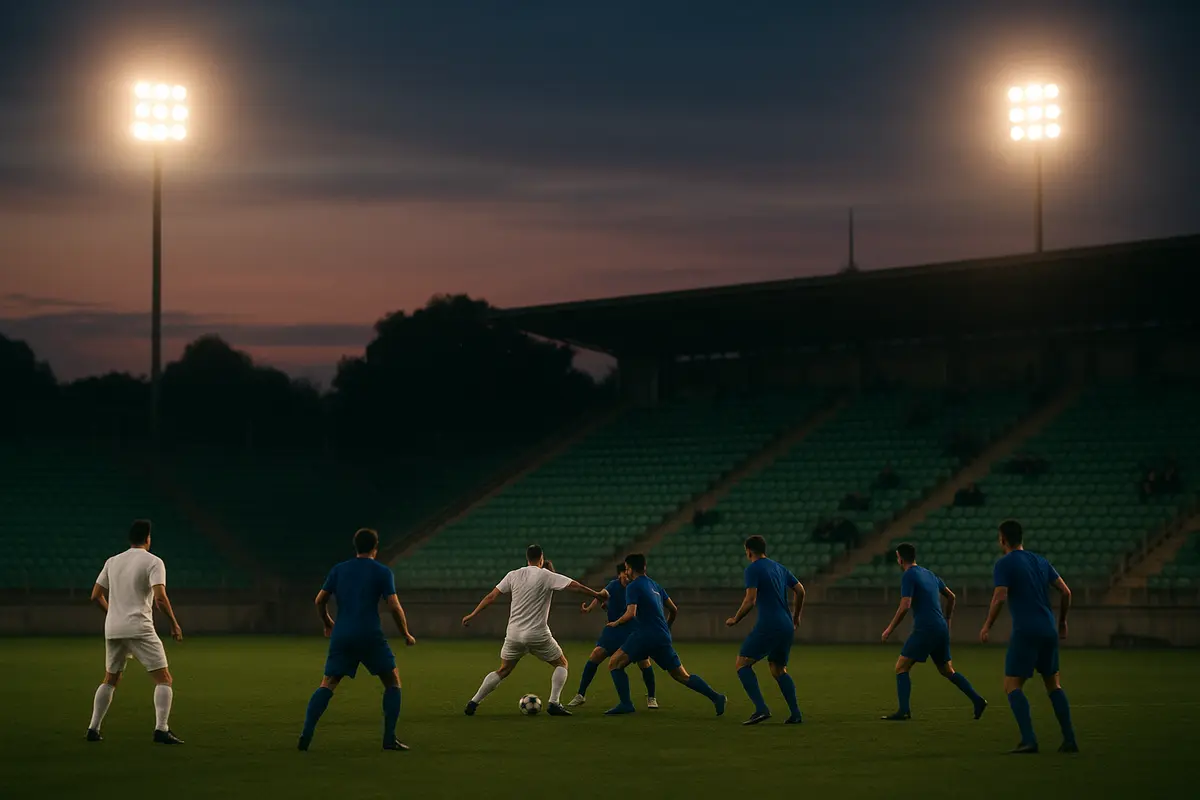
The Republic of Ireland and Israel played out a bad-tempered 1-1 draw in Backa Topola, Serbia, on Sunday night, in a UEFA Nations League Group B3 fixture overshadowed by an alleged half-time spitting incident. Troy Parrott's first-half penalty was cancelled out early in the second period, and the aftermath has been dominated by Ireland boss Heimir Hallgrímsson's call for UEFA to never pair the two countries again.
The result means Ireland have now completed both of their controversial fixtures against Israel this window without adding to the trouble that has followed the Republic of Ireland national team through this international break.
A frustrating finish behind closed doors
Played without supporters at the 4,500-capacity TSC Arena, the match was goalless until just before half-time. Parrott put the Republic of Ireland ahead before the break with a well-taken penalty, his fourth goal in three games, after Jimmy Dunne was fouled inside the box.
Ireland's lead lasted barely two minutes into the second half. Israel captain Dor Peretz earned his side a point when he poked home from close range after Oscar Gloukh's shot deflected off Liam Scales. Both sides had further chances to win it, with Republic of Ireland substitute Chiedozie Ogbene forcing a fine save from Assaf Tzur and Israel twice hitting the woodwork, but neither could find a winner.
Tunnel bust-up overshadows the scoreline
The scoreline quickly became a secondary story. The friction was clear as the teams clashed on their way off the pitch at half-time before referee Juan Martinez Munuera intervened, and further flashpoints followed after full time.
The spitting allegation
The most serious claim centred on Ireland's backroom staff. Ireland's head of athletic performance, Damien Doyle, claimed an Israel player spat at him when the teams clashed as they left the pitch for half-time.
Both camps play it down
Hallgrimsson confirmed there was an allegation, but admitted he didn't see it and declined to comment further on it. On the other side, Israel head coach Ran Ben-Shimon also said he didn't see anything. Ahead of the game, tensions had already spilled into the media room, as UEFA confirmed that two Israeli journalists were banned from the post-match press conferences after Saturday's pre-match Ireland press conference descended into chaos.
Hallgrímsson's plea: keep us apart
Speaking afterwards, the Icelandic manager made his position clear when asked whether the countries should meet again. He said there was "a big support for Palestine in Ireland" and suggested that might be a reason for UEFA to step in.
It is unlikely to happen. UEFA only introduces such restrictions when nations are in direct political conflict, as with Spain and Gibraltar, Armenia and Azerbaijan, or Kosovo kept apart from Serbia and Bosnia-Herzegovina. The governing body has already given its answer to Irish officials. UEFA has already rejected a request from the FAI to avoid Israel, with chief executive David Courell being told it would not be possible because the countries have never been in direct conflict.
The bad feeling built over two legs. The enmity between the sides grew after the Irish players wore black armbands and bowed their heads during the Israeli national anthem before the first match, and they repeated the gesture for the second, when the Israel players wore black armbands for the victims of the October 7, 2023 attacks. The first leg itself had been a rout: Ireland won 3-0 in Israel's "home" game in Debrecen, Hungary, a week before Sunday's stalemate in Serbia.
What comes next for Ireland
Group B3 table
The point does little for Ireland's promotion hopes. Following Kosovo and Austria's draw in Pristina earlier on Sunday, the result leaves the Republic of Ireland third in the group, three points off leaders Austria. Readers can follow how that picture developed in our coverage of Kosovo's meeting with Austria and the Boys in Green's earlier h2h with the group leaders in our preview of Ireland against Austria.
A possible reunion in the Euro 2028 draw
Hallgrímsson's wish may be tested sooner than he would like. The nations could be pitted against each other again when the Euro '28 qualification draw is made in Belfast on December 6. Until then, Ireland turn their attention back to club football and the rest of the Nations League campaign, with Parrott's continued scoring form — now 10 times in his last seven competitive internationals — one of the few unambiguous positives to come out of a fraught fortnight.
For now, the FAI and UEFA will have to manage the fallout from two of the most scrutinised fixtures either association has staged in years, with Irish fans able to follow further developments through our Republic of Ireland team page.